You're Living Between Two Promises (And That's Exactly Where Hope Grows)
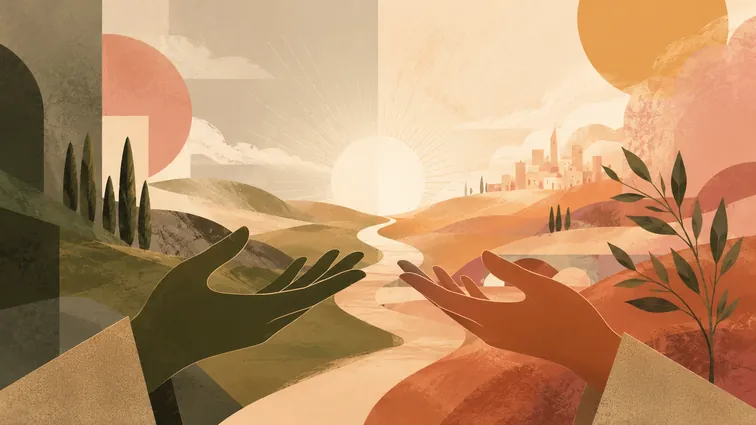
There's a phrase theologians use that sounds complicated but is actually one of the most comforting ideas in the entire Bible: "already but not yet."
It means this: God's Kingdom has already begun, but it isn't finished yet. The promises are already yes, but they haven't fully landed yet. You're standing in the middle of a story where the most important chapter has been written, but the last page hasn't turned.
And that space right there? That's where hope lives.
The Promise That Kept an Entire Nation Going
Long before Jesus showed up, the people of Israel were living on promises. God made a covenant with Abraham, pledged restoration through the prophets, and whispered a future through the poetry of the Psalms. None of it had arrived yet. But they held on anyway.
Ancient Israelites would have drawn hope from the prediction that God would send a Redeemer to restore their lives and bless them. This promise had sustained God's people since the garden of Eden.
Think about that. Centuries of waiting. Centuries of holding a promise that hadn't shown up yet. That wasn't weakness. That was faith doing exactly what it was designed to do.
Bible scholars estimate that more than 350 Old Testament prophecies were fulfilled by the birth, life, death, and resurrection of Jesus Christ. The prophecies were intended to give God's people hope and to help them identify their Savior.
350 threads, woven across centuries, all pulled together in one life. That's not coincidence. That's a God who plans very, very carefully.
"For all the promises of God find their Yes in him. That is why it is through him that we utter our Amen to God for his glory."
The "Already But Not Yet" Problem (That's Actually Not a Problem)
Here's what's interesting. When Jesus came, He didn't close the book on God's promises. He opened a new chapter.
The Bible presents the Kingdom of God as both a present reality and a future hope. When Jesus arrived, He brought the Kingdom with Him, fulfilling promises and inaugurating a new era, yet the fullness of the Kingdom awaits His return.
So right now, you and I are living in a strange, beautiful in-between. The Kingdom is here, but it's not complete. The victory has been won, but the celebration hasn't fully started yet.
We live in the "already but not yet," where the Kingdom is here but not fully realized. Our purpose is to proclaim the good news, to be a light in a restless world, knowing our true home is still to come. We are called to holy discontent: content in Christ, but unsettled by the brokenness around us, compelled to act, to love, to share hope.
That's a striking phrase: "holy discontent." You don't have to pretend everything is fine to have hope. Biblical hope isn't optimism that ignores reality. It's confidence that what God started, He will absolutely finish.
Did you know?
The word "hope" in the New Testament Greek is elpis, which doesn't mean a vague wish or a maybe. It refers to a firm, confident expectation based on something certain. Biblical hope is less "I hope it doesn't rain" and more "I know the sun will rise tomorrow." The certainty is built in.
What the Kingdom Looks Like Right Now
It can be hard to feel hopeful about a Kingdom that hasn't fully arrived. But Scripture gives us a really clear picture of what's happening right now and what's still coming.
| Aspect | Already (Now) | Not Yet (Coming) |
|---|---|---|
| Kingdom | Begun in Jesus (Luke 17:21) | Fully established at His return |
| Eternal Life | Starts the moment you believe (John 10:28) | Perfected in resurrection glory |
| Suffering | Still real and painful | Wiped away completely (Rev 21:4) |
| God's Presence | Through the Holy Spirit within us | Face to face, unhindered |
| Promise | Guaranteed by the cross | Delivered at Christ's return |
None of what's in the "Not Yet" column is wishful thinking. What God has promised He will fulfill. Paul highlighted "the hope of eternal life which God, who cannot lie, promised before time began."
God doesn't break promises. He never has. That's the whole point of the Old Testament. He waited 400 years to fulfill what He promised Abraham, and He gave them all He promised. If He did it then, He'll do it now.
Living Like the Future Is Already Real
This is where it gets practical. Because knowing all this should actually change how you live on a Tuesday afternoon when everything feels ordinary or hard or uncertain.
Believers have an unshakable hope for the future, for Christ's resurrection is a pledge of their own future resurrection. It's not just a nice idea. The resurrection is a down payment. A guarantee. God already put something real into the account.
In Christ, we are now citizens of His Kingdom, and when He returns, we will reign with Him. Citizens. Not visitors. Not applicants. Citizens, right now, of a Kingdom that has no end.
"Our citizenship is in heaven, and from it we await a Savior, the Lord Jesus Christ."
So what does that mean for a regular Wednesday? It means you're not just surviving. You're not just getting through. You're a person living inside a promise that has already been signed and sealed, waiting for the delivery that's absolutely coming.
This promise should cause us to "greatly rejoice" and fill us with inexpressible and glorious joy. With these encouraging concepts uppermost in our minds, we can resist the influences of hopelessness.
That joy isn't something you manufacture. It's something you remember. You remember what's already true, and you let that truth do its work.
Living in the "Already But Not Yet"
- Biblical hope is confident expectation, not wishful thinking. It's built on God's character, not circumstances.
- You don't have to wait for everything to be fixed to experience Kingdom life. It's already begun.
- The cross is the proof God keeps His word. If He fulfilled 350+ prophecies in Jesus, the remaining ones are guaranteed.
- Holy discontent is healthy. You can grieve what's broken while fully trusting what's coming.
- You are already a citizen of the Kingdom. Live accordingly, even on the hard days.
The In-Between Is Not a Waiting Room
Here's the thing about waiting rooms. You're just killing time until the real thing starts. But that's not what the Bible describes for us.
We are called to live as citizens of the Kingdom today, even as we anticipate the day when Jesus will return and make all things new. The in-between isn't idle time. It's active time. It's the time when your hope gets lived out in real ways, in real relationships, in a real world that desperately needs to see what a person anchored in biblical promises actually looks like.
Biblical hope is far more than mere optimism. It's a confident expectation in God's faithfulness, anchored in God's character, proven through His past faithfulness, and guaranteed by His promises for the future.
The promises God made haven't expired. They were never conditional on how history was going at any given moment. They rest entirely on who God is.
And He's still exactly who He said He was.