Bread, Blood, and Binding Oaths: Ancient Near Eastern Customs That Shaped the Bible
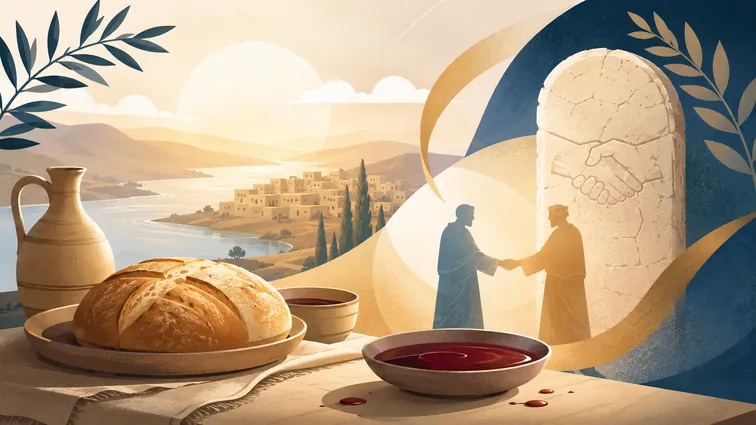
Most of us read the Bible through a 21st-century Western lens. We see Abraham feeding three strangers under a tree and think, "How nice." We read about God cutting a covenant with animals and think, "That's strange." But if you understood Ancient Near Eastern customs the way the original audience did, you'd see something completely different - something rich, weighty, and deeply intentional.
The Ancient Near East wasn't just the setting of the Bible. It was the cultural soil from which biblical theology grew.
A World Built on Tribe and Tradition
Societies in the Ancient Near East, specifically Israel, were tribal and traditional - tribal in that people lived in communities made up of their extended family and lived in the same place for several generations; traditional in that their society was governed by the local traditions and customs of the family, and people answered to the patriarch of the tribe when they violated these traditions.
This is a world radically unlike ours. There were no anonymous city neighborhoods. No government bureaucracy to appeal to. Your family name and tribal affiliation were your identity, your security, and your law all at once.
In the modern western world, the family is separate from and not important to the government, and the government controls everything. In the Ancient Near East, familial tribes were central in the culture, and the patriarch of the family controlled everything.
Some common manners and customs practiced by people in the Bible included hospitality, respect for elders, strict adherence to dietary laws, ritual cleanliness, and offering sacrifices. These weren't optional add-ons. They defined who you were.
Core Features of Ancient Near Eastern Society
- Identity was tied to tribe and family lineage, not individual achievement
- The patriarch held authority over legal, social, and spiritual matters
- Customs like hospitality and covenant-keeping carried the weight of law
- Violating community customs brought deep social shame and consequence
Hospitality Wasn't Optional - It Was Sacred
Here's something that surprises a lot of people: hospitality in the Ancient Near East was not merely a courtesy but a moral obligation, often viewed as sacred. Travelers relied on the generosity of strangers, as inns and lodging facilities were scarce and rudimentary.
Think about that. If you turned someone away, you weren't just being rude. You were potentially condemning them.
In the Ancient Near East, hospitality was the process of "receiving" outsiders and changing them from strangers to guests. That transformation - from stranger to guest - carried real social and even legal implications. A host could infringe the requirements of hospitality by insulting the guests, by any show of hostility or rivalry, or by neglecting to protect the guests and their honor.
The stakes were serious on both sides. It was supported by the thought that the host himself might some day be a stranger, and by the possibility that the stranger was divinely sent. That last part is huge. You might be hosting an angel. You might be hosting God himself.
In the Ancient Near East, hospitality was a sacred duty, and guests were considered as representatives of God. This is reflected in numerous biblical stories, such as the account of Abraham welcoming three strangers in Genesis 18.
"The LORD appeared to Abraham near the great trees of Mamre while he was sitting at the entrance to his tent in the heat of the day. Abraham looked up and saw three men standing nearby. When he saw them, he hurried from the entrance of his tent to meet them and bowed low to the ground."
Notice Abraham didn't wait to see who they were. He ran. The quintessential example takes place when three men (who turn out to be divine) journey by Abraham's tent. He runs out and invites them to stop. When they accept, he prepares a lavish feast for them.
There's also a fascinating social dynamic in how shared meals worked. If the guest was outside of the tribe or covenant, then the host would not eat with the one they were showing hospitality to. One ate meals only with those they were willing to call family. So when Jesus sat and ate with tax collectors and sinners (Matthew 9), the Pharisees weren't just grossed out - they were scandalized. Sharing a meal was a statement of covenant solidarity.
Did You Know?
The Hebrew word often associated with hospitality, ḥesed (חֶסֶד), conveys kindness, loyalty, and love, central to God's covenant with His people. This same word is translated "lovingkindness" or "steadfast love" throughout the Psalms - the very character of God described through a hospitality concept.
The Covenant: More Than a Promise
The word "covenant" gets thrown around a lot in church circles. But in the Ancient Near East, a covenant wasn't just a handshake agreement. It was a binding, ritualized, legally structured event that could involve animal sacrifice, sworn oaths, shared meals, and written documents.
God's covenant with Israel was set forth in a form common in the Ancient Near East, a format known as a Suzerain-Vassal Treaty. In these treaties, the "suzerain," or superior ruler, promised blessings for loyalty and obedience, and curses for rebellion.
Scholars have found remarkable parallels between biblical texts and ancient Hittite treaties. Basing his work on the study of Hittite vassal treaties, G.E. Mendenhall argued that the Sinai covenant seems to have been similar in form to ancient Near Eastern vassal treaties of the fourteenth-thirteenth centuries BC. The pattern of these treaties is: Preamble introducing the sovereign; Historical Prologue outlining previous relations of the parties; Stipulations; Document clause; Witnesses; and Curses and Blessings.
Sound familiar? That's basically the structure of Deuteronomy.
| Treaty Element | Hittite Suzerain Treaty | Biblical Covenant (Deuteronomy) |
|---|---|---|
| Preamble | King identifies himself | "I am the LORD your God" (Deut. 5:6) |
| Historical Prologue | Recounts king's past deeds | Recounts the Exodus and wilderness (Deut. 1 - 4) |
| Stipulations | Laws the vassal must keep | The Ten Commandments and laws (Deut. 5 - 26) |
| Blessings & Curses | Rewards for loyalty / punishment for betrayal | Deut. 27 - 28 blessings and curses |
| Witnesses | List of deities as witnesses | Heaven and earth called as witnesses (Deut. 30:19) |
The rituals that accompanied covenant-making were equally striking. Treaty texts essentially served as partial scripts for a physical performance of a series of ritual actions, including an oral recitation of the terms of the treaty, ritual display of the written text of the treaty, animal sacrifice, or the enactment of curses to be meted out upon violators of the treaty. In combination with the written text, the ritual represents the norm by which binding agreements were expressed and enacted in the Ancient Near East. Without these actions, the agreement would not be binding or effectual.
God required Abraham to participate in a sacrificial ceremony known as "the covenant between the parts," a covenant of obligation with an implied punishment - that Abraham and his family would be torn asunder if they betrayed the covenant (Genesis 15:8 - 17) - an interpretation strengthened by similar connotations in Jeremiah 34 and in the ancient Near Eastern Sefire Treaties.
"So the LORD made a covenant with Abram and said, 'To your descendants I give this land, from the Wadi of Egypt to the great river, the Euphrates.'"
What's remarkable about Genesis 15 is what God actually did. God himself participated in the ceremony by passing between the pieces of the sacrifice, indicating his own commitment to the covenant (from a Christian viewpoint, God is possibly implying that he himself would be willing to be "torn asunder," suffering the effects of the broken covenant).
In other words, God took on the curse himself. Centuries before the cross, the ritual was already pointing there.
Why Any of This Matters
God speaks to humanity in terms we can understand. If He were to speak in heavenly terms we most likely would not understand. So He speaks to us in earthly terms. God uses this same treaty structure when He makes a covenant with Israel, because they will understand it.
That's a profound point. God didn't invent covenant language from scratch. He took the cultural framework his people already lived inside, and he filled it with new, eternal meaning.
Covenants in the Ancient Near East made families out of those who were not family. Which is exactly what God was doing with Israel, and ultimately with all of us.
Reading Tip
Next time you read a passage that feels culturally distant - a strange ritual, an elaborate meal, an oath sworn before witnesses - ask yourself: what were the social stakes in that moment? What did that action mean to someone who lived in that world? Chances are, the meaning runs far deeper than the text surface suggests.
The Ancient Near East wasn't an obstacle to understanding the Bible. It was the lens God chose to use. When Abraham fed strangers under a tree, when Jacob set up a pillar and swore an oath with Laban, when the blood of animals ratified a promise between God and man - these weren't just regional customs. They were a language. And God was speaking it fluently.